Live CCTV in Korea: Official Sites for Traffic, Island Ports, Rivers and Mountains
TL;DR
- Many road traffic cameras in Korea can be watched live: the police's UTIC map covers city roads nationwide, the National Transport Information Center covers expressways and national roads, and Seoul's TOPIS covers Seoul.
- Some agencies also stream disaster and nature cameras: Ongjin County's island ports (90 cameras on 2026-10-24), river level points, 18 national park cameras and five on Hallasan.
- Street crime prevention cameras are, as a rule, not streamed. Korean law bars using their footage beyond its purpose, including giving it to third parties, and a person may only request footage that shows themselves.
You can watch Korea's road traffic cameras, and a set of disaster and nature cameras (island ferry ports, river level points, national park summits), on official Korean sites for free. As a rule, crime prevention cameras on residential streets are not streamed to the public.
The national CCTV standard dataset (전국CCTV표준데이터) lists purposes and does not say which cameras are public. Of its 381,036 raw rows (downloaded 2026-09-20), 61.7% list crime prevention as the purpose, 1.0% traffic information collection and 2.4% disaster. Streamed cameras are not all among them. Seoul's TOPIS and the national road cameras are not in the dataset, and Ongjin's streamed port cameras are filed under crime prevention.
Using Korean-only camera sites
Every camera page I checked is in Korean, but a few labels get you most of the way.
| Korean label | Meaning | Where you see it |
|---|---|---|
| CCTV, CCTV 정보 | Camera layer or list | UTIC, TOPIS and city traffic maps |
| 섬 별 CCTV, 구역 별 CCTV | Cameras by island, by district | Ongjin disaster CCTV |
| 실시간영상 | Live video | Korea National Park Service |
| 점검 중 | Under maintenance (no stream right now) | Camera cards on the Korea National Park Service page |
Most sites open on a map. Tap a camera icon, or its name in the list, and the video starts.
Traffic cameras
| Site | Roads | Run by |
|---|---|---|
| UTIC (도시교통정보센터) | City roads nationwide | Korean National Police Agency, Road Traffic Authority |
| National Transport Information Center (국가교통정보센터) | Expressways, national roads | Ministry of Land, Infrastructure and Transport |
| Seoul TOPIS | Seoul | Seoul Metropolitan Government |
| Gyeonggi Traffic Information Center | Gyeonggi Province | Gyeonggi Province |
| Incheon Traffic Information Center | Incheon | Incheon |
| Busan Traffic Information Service Center | Busan | Busan |
| Daegu traffic information | Daegu | Daegu |
| Ulsan Traffic Management Center | Ulsan | Ulsan |
UTIC pulls cameras from many agencies onto one map. Expressway and national road cameras come from the National Transport Information Center; a UTIC notice dated 2026-09-02 drops those roads from UTIC's open-data camera list and points developers there.
Island ports, rivers and mountains
| Site | What it shows | Run by |
|---|---|---|
| Ongjin County disaster CCTV (옹진군 재난 CCTV 시스템) | Ferry ports and harbors on Baengnyeongdo, Yeonpyeongdo, Deokjeokdo and other islands | Ongjin County, Incheon |
| Busan Safety ON (부산 안전ON) | Disaster watch cameras on Busan streams and roads | Busan |
| Yeongsan River Flood Control Office water level video | River level points in Jeonnam-Gwangju, Jeonbuk State, Jeju and nearby areas | Yeongsan River Flood Control Office (Ministry of Climate, Energy and Environment) |
| Korea National Park Service live video | 18 park cameras, including Baegundae (Bukhansan), Cheonwangbong (Jirisan) and Ulsanbawi (Seoraksan) | Korea National Park Service |
| Hallasan live CCTV | Baengnokdam crater, Witse-oreum and three more points on Hallasan | Hallasan National Park office, Jeju |
| KBS disaster portal CCTV | Disaster watch points on coasts and roads | KBS (public broadcaster, not a government agency) |
The Hallasan page shows five points: the Baengnokdam summit crater, Wanggwalleung, Witse-oreum, Eoseungsaengak and the 1100 road.
Ongjin's system covers the islands off Incheon that the county administers. Because it opens only by IP address over http, your browser may mark it "Not secure". The footer gives the Ongjin County office address (매소홀로 120, Michuhol-gu, Incheon), and the county's CCTV policy says KT runs its coastal disaster cameras under contract.
On the national park page, a camera shows "점검 중" whenever its stream does not answer within two seconds, so the count changed from one load to the next on the same day. The oceans ministry's coastal monitoring page shows beaches without streaming video. Its code reloads a captured photo every 4 seconds, and the page itself says some beaches may show only the latest photo.
Why crime prevention cameras stay private
| Camera type | Streamed to the public | Related provisions |
|---|---|---|
| Traffic information | Yes, on traffic center sites | Personal Information Protection Act, Article 25(1)5: installing a camera "to collect, analyze and provide traffic information" is an allowed purpose. Road Traffic Act Article 145(1) tells the police to provide traffic information to the public promptly |
| Disaster, river, coast, park | Some agencies stream them | Depends on the agency |
| Crime prevention, child safety, facility safety | Not as a rule | Personal Information Protection Act, Article 18; Standard Personal Information Protection Guidelines, Article 40 (no use beyond the purpose of collection and no provision to third parties without an exception) and Article 44(1) (you may request only footage that shows you) |
Providing information to the public is part of a traffic camera's legal purpose. A crime prevention camera is installed "for the prevention and investigation of crime" (Article 25(1)2). Article 18 of the same Act bars using personal information beyond the purpose it was collected for, or giving it to third parties beyond that scope, and Article 40 of the regulator's guidelines applies that rule to cameras. Article 40 allows no use outside the purpose and no provision to third parties unless an exception applies, such as consent, another law, or an urgent need to protect someone's life, body or property.
You can ask the operating agency for footage that shows you; how to request CCTV footage in Korea walks through it, including for people who don't read Korean, and how long CCTV footage is kept covers the time limits. A public agency may also hand footage to investigators when a criminal investigation needs it (Article 18(2)7).
Ongjin: disaster cameras streamed, zero disaster cameras in the data
| Source | Ongjin County CCTV |
|---|---|
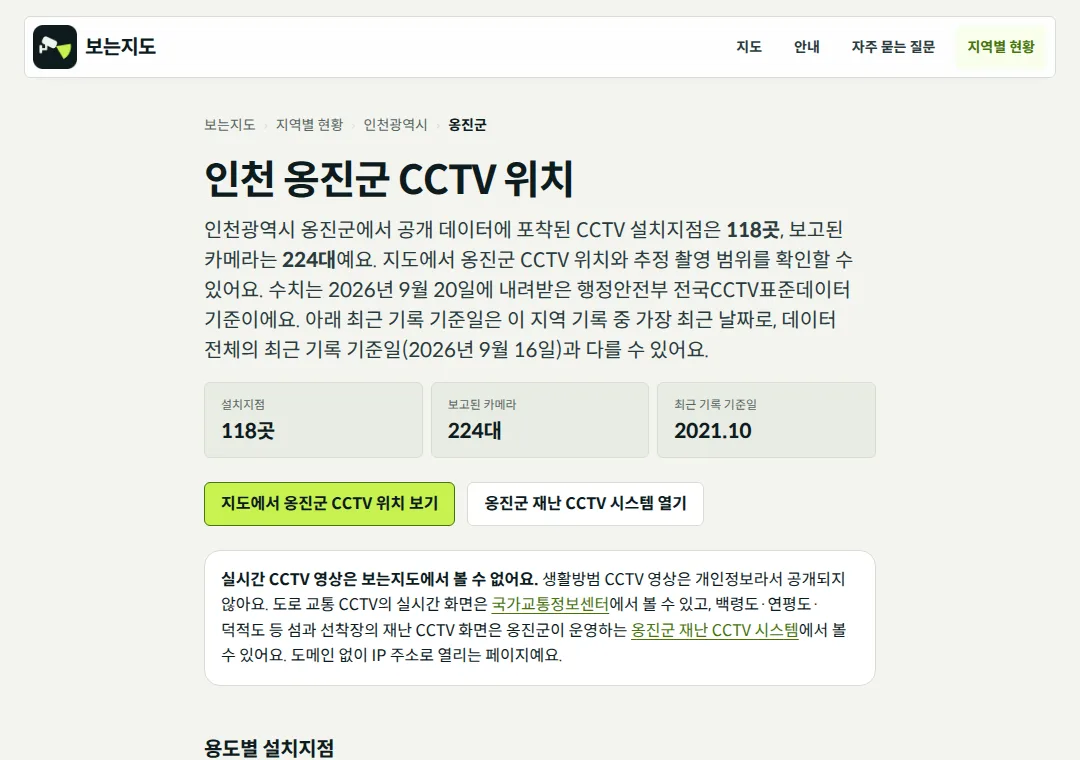
| National CCTV dataset (downloaded 2026-09-20) | 118 sites, 224 cameras. 115 sites listed as crime prevention, 3 as waste dumping enforcement, none as disaster. 115 sites managed by the county's disaster and safety officer. Newest record dated October 2021 |
| Ongjin County CCTV operating policy | 573 cameras under the disaster and safety division for "crime prevention and disaster prevention" |
| Ongjin disaster CCTV system (counted 2026-10-24) | 90 cameras in 7 districts; 46 have a port, harbor or pier word (선착장, 항, 부두) in their name |
Going by the dataset, Ongjin has no disaster cameras at all. The 115 sites its disaster and safety officer manages are all filed under crime prevention, yet the same county streams its island ports as disaster CCTV. The purpose field alone does not tell you which cameras are public. The dataset also lists 224 cameras against the policy's 573. Its newest Ongjin record is from October 2021, so cameras installed since then may be missing. How current Korea's CCTV data is compares record dates across agencies.
Viewcone (보는지도) shows the dataset row of that table on its Ongjin page, with a button to the county's disaster CCTV system next to its map button. Viewcone does not show video. It maps public CCTV locations from the open data with an estimated field of view, and tapping a site shows its purpose and managing agency, so you can see which public cameras the open data places on a street. Finding CCTV locations near you explains how.
Sources
Dates are the ones each agency states. I checked the law articles in their current versions on the National Law Information Center on 2026-10-24. This is general information, not legal advice for a specific case.
- Personal Information Protection Act, Articles 18 and 25 (Act No. 21445, in force 2026-09-11): https://www.law.go.kr/법령/개인정보보호법/제18조
- Standard Personal Information Protection Guidelines, Articles 40 and 44 (PIPC Notice No. 2025-4, in force 2025-04-11): https://www.law.go.kr/행정규칙/표준개인정보보호지침
- Road Traffic Act, Article 145: https://www.law.go.kr/법령/도로교통법/제145조
- UTIC notice on open-data CCTV use (2026-09-02): https://www.utic.go.kr/center/newNoticeRead.do?id=11082
- Ongjin County CCTV operating policy: https://www.ongjin.go.kr/open_content/main/guidance/personal_cctv.jsp
- Ongjin County disaster CCTV system: http://218.148.169.193/
- Korea National Park Service live video: https://www.knps.or.kr/portal/main/contents.do?menuNo=8000168
- Ministry of the Interior and Safety, national CCTV standard dataset (downloaded 2026-09-20): https://www.data.go.kr/data/15013094/standard.do
FAQ
A traffic camera site won't load from outside Korea. What can I try?
When I tried from a server outside Korea, the National Transport Information Center and Korea Expressway Corporation sites did not respond, while Seoul TOPIS, UTIC and the Ongjin system did on the same day. If one site fails, try another in the table; UTIC's map covers city roads across the country.