How Long Is CCTV Footage Kept? Retention Rules by Country, and What Korea's 381,036 Public Camera Records Show
TL;DR
- Regulators in the UK, Canada, Australia and Japan give no fixed number of days: footage may be kept only as long as its purpose needs.
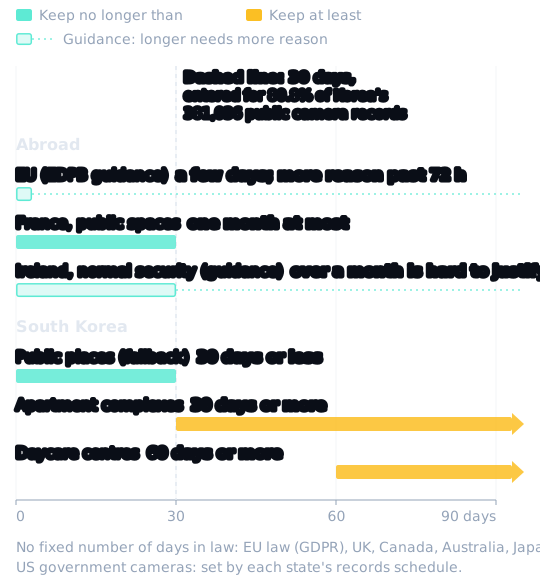
- Where numbers exist, they are short: EU guidance expects deletion within a few days and more justification beyond 72 hours, France caps public-space video at one month, and Ireland's regulator says ordinary security footage is hard to justify beyond a month.
- In Korea's national CCTV dataset, 80.8% of 381,036 public camera records list a 30-day retention period and none lists a year or more.
 See CCTV near you on ViewconeOpen the map
 None of the regulators I checked in the UK, the EU, Canada, Australia or Japan sets a fixed number of days: footage may be kept only as long as the reason for recording needs it. The figures that do exist are short: a few days in EU guidance, a one-month cap for public-space video in France, one month in Irish guidance, and 30 days or less as Korea's default. Because the maximums that exist are a month or less, ask for a recording within days, not weeks.
I build Viewcone, a map of public CCTV in South Korea made from the government's national CCTV standard dataset (전국CCTV표준데이터). That dataset has a retention field for every record, so alongside the rules below you can see what 381,036 public camera records actually list.
Retention rules side by side
| Country or region | What the rules say | Source |
|---|---|---|
| EU | No fixed period. In most cases footage should be erased after a few days, ideally automatically; the longer beyond 72 hours, the more justification is needed | EDPB Guidelines 3/2019 (guidance) |
| United Kingdom | UK GDPR and the DPA 2018 set no minimum or maximum. Keep it for the shortest period your purpose needs | ICO guidance; Surveillance Camera Code of Practice |
| Ireland | The law sets no period. For a normal security system, retention beyond one month is hard to justify | Data Protection Commission guidance (Nov 2023) |
| France | Public-space video: the period in the prefect's authorisation, never more than one month | CNIL |
| United States | Set by each state's records schedule for state and local government cameras. Washington local governments: keep footage with no incident for at least 30 days or until no incident is found, whichever is sooner, then destroy it as the state recommends. Texas local governments: their own discretion | Washington State Archives CORE GS50-06B-18; Texas State Library Local Schedule GR1075-25 |
| Canada | Only as long as necessary for the purpose, then destroyed securely | Office of the Privacy Commissioner |
| Australia | Destroyed or de-identified when no longer needed; state and territory laws also apply | OAIC |
| Japan | No national figure. Set a period based on need and try to delete without delay when no longer needed | Personal Information Protection Commission Q&A 5-4 |
| South Korea | The period in the operator's published policy; if a minimum period is hard to set, 30 days or less. Apartment complexes: 30 days or more. Daycare centres: 60 days or more | Standard Personal Information Protection Guidelines art. 41; apartment and childcare rules |
United Kingdom
The ICO says: "The UK GDPR and the DPA 2018 do not prescribe any specific minimum or maximum retention periods which apply to surveillance systems or the information you may process." It adds that footage "shouldn't be kept for six months merely because the manufacturer's settings on the surveillance system allow retention for this length of time." The Home Office Surveillance Camera Code, which certain public authorities in England and Wales must have regard to and other operators are encouraged to adopt, says it is "not, therefore, possible to be prescriptive about maximum or minimum periods." The ICO also notes that footage may be kept longer when police investigating a crime ask for it to be preserved.
EU, Ireland and France
The European Data Protection Board says damage is usually noticed "within one or two days," so footage should in most cases be erased "after a few days," and "the longer the storage period set (especially when beyond 72 hours), the more argumentation" is needed. This is guidance; member states may have their own rules.
Ireland's Data Protection Commission ties its figure to the one-month point for serving a letter of claim after an accident under Irish personal injury law, so a 30-day period "may thus be deemed reasonable" for defending such a claim, while for a normal security system "it would be difficult to justify retention beyond one month."
France is one of the few places with a number in law for public spaces: the period is set in the prefect's authorisation and "ne peut excéder un mois" (cannot exceed one month), and the CNIL adds that a few days is usually enough to check after an incident.
United States
There is no single national number in the sources I checked. For state and local government cameras, the state's records schedule decides; two examples: Washington's common schedule for local governments sets minimum retention periods. It covers "Audio/visual recordings (such as CCTV, dash cams, etc.)" with no incident and says to retain them "for 30 days after date record created or until determined that no security incident has occurred, whichever is sooner." Footage of an actual incident falls under a separate security-incident series. Texas lists surveillance video as "AV," as long as administratively valuable, which leaves the period to each local government. These schedules cover government records; businesses are covered below.
Canada, Australia and Japan
Canada, Australia and Japan: keep recordings only while they serve their purpose, then destroy or de-identify them. Australia's privacy regulator adds that state and territory surveillance laws also apply, and Japan's commission asks businesses to set a retention period based on need.
Shops, hotels and other businesses
None of these regulators gives businesses a separate number; the same purpose test applies. Two of the lines quoted above are aimed squarely at ordinary premises: the ICO's warning against keeping six months of footage just because the recorder allows it, and the Irish regulator's one-month line for a normal security system. Canada's guidelines for the private sector say recordings "should only be kept as long as necessary to fulfill the purpose of the video surveillance." In practice a shop or hotel keeps whatever its recorder is set to keep, so the reliable way to find out is to ask the business directly, and soon.
What 381,036 public camera records in Korea list
Korea's rule is unusual because it gives a default number. Operators must publish an operating policy that states the retention period. If they cannot work out the minimum period their purpose needs, the default is 30 days or less after recording. When the period ends, footage has to be destroyed without delay, and electronic files must be deleted so they cannot be restored. Apartment complexes and daycare centres work the other way: they must keep footage for at least 30 and 60 days.
The national CCTV standard dataset has a retention-days field filled in by each managing agency. I counted every row of the file downloaded on 2026-09-20. These are the values agencies entered, not measurements of how long recorders really keep video.
| Retention entered | Records | Share |
|---|---|---|
| 30 days | 307,719 | 80.8% |
| Blank | 61,788 | 16.2% |
| 31 days | 7,989 | 2.1% |
| 1-29 days | 2,534 | 0.7% |
| 0 days | 505 | 0.1% |
| 32 days or more (up to 180) | 501 | 0.1% |
| Total | 381,036 | 100% |
- Weighted by camera count, the 30-day rows hold 83.8% of the cameras in the raw file.
- The longest values are 180 days (6 records) and 90 days (49 records, 44 of them from one city hall, Gunpo). No record lists a year or more.
- Of the 319 managing agencies with 10 or more records, 271 (85%) enter one value for all their cameras, 213 of them 30 days. Retention is mostly set per agency, not per camera.
- Short values cluster by purpose: 12.4% of traffic-information records and 10.9% of illegal-dumping records list 1-29 days, against 0.1% of neighbourhood crime-prevention records.
A 30-day default is longer than the "few days" EDPB expects and close to France's one-month cap and Ireland's one-month guidance.
Getting footage before it is deleted
Because footage must be destroyed once the period ends, the useful step is to contact whoever runs the camera immediately and ask them to keep the recording while you make a formal request. In Korea, Viewcone, a Korean-language map, shows each public camera's purpose and managing agency when you tap it, which tells you which agency to contact. The Korean request process is in How to request CCTV footage in Korea.
How the counts were made
- Data: Korea Ministry of the Interior and Safety, national CCTV standard dataset (data.go.kr 15013094), CSV downloaded 2026-09-20, 381,036 rows. It is the same file Viewcone's map is built from.
- The map merges duplicate locations and drops rows without usable coordinates (258,376 sites). Retention is recorded per row, so this count uses every raw row. Camera shares use the raw camera-count column (700,548 cameras).
- Shares are rounded to one decimal place.
Sources
- Guidelines 3/2019 on processing of personal data through video devices, European Data Protection Board, version 2.1 (26 February 2020), paragraph 121
- Video surveillance: how can we comply with the data protection principles when using surveillance systems?, Information Commissioner's Office
- Amended Surveillance Camera Code of Practice, Home Office, Principle 6 and paragraph 6.2
- Guidance on the Use of CCTV for Data Controllers, Data Protection Commission (Ireland), November 2023
- La vidéoprotection, CNIL
- Local Government Common Records Retention Schedule (CORE) 5.0, Washington State Archives, October 2024, page 103
- Local Schedule GR, Texas State Library and Archives Commission, item GR1075-25
- Guidelines for Overt Video Surveillance in the Private Sector, Office of the Privacy Commissioner of Canada
- Security cameras, Office of the Australian Information Commissioner
- Q&A on the APPI guidelines (Japanese), Personal Information Protection Commission, Q5-4
- Standard Personal Information Protection Guidelines (Korean), articles 2(11) and 41, PIPC Notice 2025-4
- Enforcement Rule of the Multi-Family Housing Management Act (Korean), article 8(2)(3); Infant Care Act (Korean), article 15-4(3)
- National CCTV standard dataset (Korean), data.go.kr
- Rules and guidance were checked on 2026-10-18 against the versions online that day. This post summarises retention rules as general information; for a legal question about a specific case, ask the operator or a lawyer.
See CCTV near you on ViewconeSearch a neighborhood, place or street name to see public CCTV locations and estimated coverage. Free, no sign-up.Open the map