Do Parks in Korea Have CCTV? The Law and 4,805 Park Sites in Open Data
TL;DR
- Under Article 19-2 of Korea's Urban Parks Act, the local government that manages an urban park must install and run CCTV and emergency bells at its main spots where crime or safety accidents are a concern.
- In the open data downloaded 2026-11-17, 4,805 public CCTV sites with 13,129 cameras have an address that mentions a park.
- Of those 4,805 sites, 3,428 (71%) are for crime prevention.
- Addresses that mention a park come from only 75 of 228 local government codes, so the real number of park cameras can be higher.
Korean law requires CCTV and emergency bells (alarm buttons) at the urban park spots where crime or accidents are a concern. Counting only public CCTV sites whose address mentions a park, there are 4,805 nationwide. Only some local governments write park names into addresses, so the real number can be higher.
To see the public CCTV at a park near you, search for the park or the neighborhood on Viewcone.
Does Korean law require CCTV in parks?
Yes. Article 19-2 of the Act on Urban Parks, Green Areas, etc. (the Urban Parks Act) says the park authority must install and manage CCTV and emergency bells at the main spots of urban parks where crime or safety accidents are a concern. The park authority is the head of the local government that manages the park: a mayor, a county head or the governor of a special self-governing province such as Jeju. The article was added on 2017-04-18.
Neither the law nor the ministry guideline sets a number of cameras or a spacing. The land ministry's guideline on urban park standards names the places instead: park entrances, children's play areas and other spots that need watching, and spots that keep blind areas small, with lighting for night use.
The duty applies to urban parks. These include neighborhood parks, children's parks and pocket parks, and themed parks such as history parks and waterside parks (Article 15 of the Act).
How many park cameras are in the open data?
In the national CCTV standard dataset (전국CCTV표준데이터) of the Ministry of the Interior and Safety, downloaded 2026-11-17, 4,805 public CCTV sites with 13,129 cameras have an address that mentions a park. That is 1.9% of the 254,134 sites on the map, with a median of 2 cameras per site. Viewcone counts records with the same spot, purpose and agency as one site.
I looked for parks in the place notes that agencies write into the address field. For example, the Jongno District Office in Seoul writes "서울특별시 종로구 북촌로 134-1 (삼청공원)", an address with Samcheong Park in parentheses, and lists 7 sites with 18 cameras under Samcheong Park addresses. I left out 698 sites where 공원 (park) appears only in a road or building name, such as Gongwon-ro (a street) or an apartment building named after a park. Sites described as at a park's entrance or in front of a park are included.
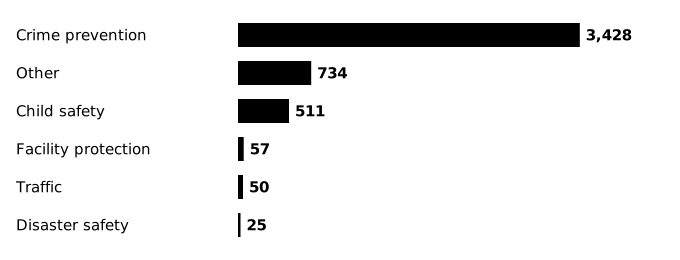
7 in 10 park sites are for crime prevention. The 734 "other" sites are ones the agency listed as other, multi-purpose or littering enforcement.
Park cameras the count misses
Addresses that mention a park come from only 75 of the 228 local government codes in the data, one code for each city, county or district. If another local government writes only a street address for its park cameras, those cameras are on the map but not in the 4,805.
The open data also leaves out private CCTV, such as cameras at a playground inside an apartment complex. A park with no dots on Viewcone can still have cameras.
Checking a park's cameras on the map and on site
- See the sites on the map: search for the park on Viewcone. Small parks may not show up by name, so search for the neighborhood (dong) or a nearby station or school instead. With only the 생활방범 (crime prevention) button on, park sites listed as 기타 (other) drop off the map, so turn 기타 on too. Tap a dot to see its purpose, the managing agency and the data date. The interface is in Korean; How to check CCTV locations near you walks through it.
- Find the operator on the CCTV sign: an operator of CCTV in a public place must put up a sign with the purpose and place, the recording range and hours, and a contact person (Article 25(4) of the Personal Information Protection Act). The contact on the sign tells you who runs the cameras.
- Ask for a camera where one is needed: the park authority must hear residents' and police views every year when it installs cameras and bells (Article 15-2 of the Act's Enforcement Decree). If a spot needs CCTV or an emergency bell, ask the city, county or district office that manages the park. How to get a public CCTV camera installed on your street covers what to write.
- Request footage fast: of the 5,275 raw park CCTV records (one site can have several) that list a retention period, 5,271 say 30 days (how long CCTV footage is kept). Footage can be deleted 30 days after it is recorded, so request it before then, as in How to request CCTV footage in Korea.
FAQ
Can I see where the emergency bells are?
No. The Urban Parks Act asks for emergency bells along with CCTV, but the national CCTV dataset has no emergency bell field, so Viewcone does not show them.
Sources
Law articles are the versions in force, read on the Korean Law Information Center on 2026-11-20.
- Act on Urban Parks, Green Areas, etc. (도시공원 및 녹지 등에 관한 법률), Articles 15 and 19-2 (Act No. 21039, in force 2026-08-27)
- Enforcement Decree of the Act on Urban Parks, Green Areas, etc., Article 15-2 (Presidential Decree No. 36586, in force 2026-09-18)
- Ministry of Land, Infrastructure and Transport, Guideline on detailed standards for urban parks and green areas by type (도시공원·녹지의 유형별 세부기준 등에 관한 지침), 3-4-2 (12) (Directive No. 1808, in force 2024-10-23)
- Personal Information Protection Act (개인정보 보호법), Article 25 (Act No. 21445, in force 2026-09-11)
- National CCTV standard dataset (전국CCTV표준데이터), Ministry of the Interior and Safety, downloaded 2026-11-17