How Many CCTV Cameras Does South Korea Have? Three Official Counts Compared
TL;DR
- Public institutions in South Korea ran 2,054,387 CCTV cameras in public places in 2025, according to the Personal Information Protection Commission's annual statistics, about 40 for every 1,000 registered residents.
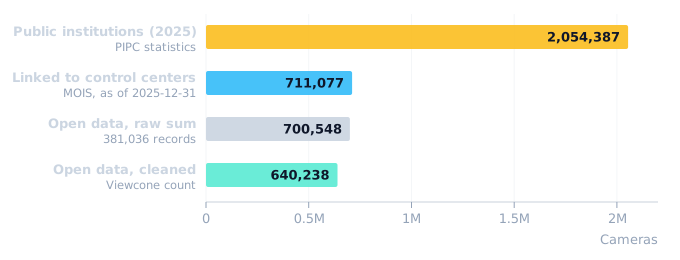
- Narrower counts: 711,077 cameras linked to local integrated control centers (a government table as of 2025-12-31) and 700,548 in the national CCTV open data, which Viewcone cleans to 640,238 by dropping unlocated rows and repeated uploads.
- The numbers cover different sets of cameras, so they cannot be added or subtracted. I found no government statistic that counts private cameras in shops, apartments and homes.
The official count is 2,054,387 CCTV cameras run by public institutions in South Korea in 2025. It comes from the Personal Information Protection Commission (PIPC, 개인정보보호위원회), which publishes it every year on e-Narajipyo (e-나라지표), the government's portal for national indicators. It covers cameras that ministries, local governments, public corporations and schools operate in places open to the public. Cameras that shops, apartment complexes and households put up are not in it.
That works out to about 40 public cameras for every 1,000 registered residents, or one for every 25. Korea had 51,117,378 registered residents at the end of 2025 by the Ministry of the Interior and Safety's resident registration count, which covers Korean nationals (including those registered as living abroad) and leaves out foreign residents.
You will also see 711,077 quoted as the number of CCTV cameras in Korea. It is a government figure too, but it counts a much narrower set. To see how far apart the counts are, I recounted the government's national CCTV open data from its raw file and added up the other two totals from the original tables. That open data is also what Viewcone (보는지도), my map of public CCTV in Korea, is built from.
Which number to use
| Number | What it counts (source, date) | Use it for |
|---|---|---|
| 2,054,387 | Cameras public institutions run in public places (PIPC, 2025) | How many public cameras Korea has, and the trend over time |
| 711,077 | Local government cameras linked to an integrated control center (Ministry of the Interior and Safety, 2025-12-31) | How many cameras a district's control center is linked to |
| 700,548 | Camera column summed over all 381,036 records of the national CCTV open data (same ministry, downloaded 2026-09-20) | The size of the raw open data |
| 640,238 | Viewcone's cleaned count of the same open data | Where the public cameras near a place are; of the three sources, only the open data has locations |
The four numbers come from three sources, listed from largest to smallest. 700,548 and 640,238 are the same file before and after cleaning. 711,077 is collected through a different channel, so it does not line up with the open data camera for camera. The sets overlap, so adding them counts the same cameras twice. Because dates and reporting channels differ, subtracting one from another does not give you the "unpublished" cameras. Camera counts also say little about how safe an area is; the research is summarized in Does more CCTV make a neighborhood safer?.
2,054,387: every camera public institutions report
The PIPC indicator "Installation and operation of CCTV at public institutions" (공공기관 CCTV 설치 및 운영) defines its number as the cameras each public institution counts in its own check and registers in the commission's reporting system. Institutions register their figures by the end of March each year, and the statistics are compiled in April and May.
"Public institution" has the meaning in Korea's Personal Information Protection Act: the administrative offices of the National Assembly, the courts, the Constitutional Court and the National Election Commission, central ministries and their agencies, and local governments, plus the bodies its enforcement decree adds, which include public corporations, local public enterprises and schools at every level. The indicator leaves out cameras in non-public places that ordinary people cannot enter.
By purpose, the 2025 figure breaks down as follows. The categories are the cases in which the Act allows a camera in a public place (Article 25(1), items 2 to 6), listed in the Act's order.
| Purpose (2025) | Cameras | Share |
|---|---|---|
| Crime prevention | 1,076,857 | 52.4% |
| Facility management and fire prevention | 856,171 | 41.7% |
| Traffic enforcement | 75,366 | 3.7% |
| Traffic information collection and analysis | 44,377 | 2.2% |
| Statistics only (e.g. counting visitors) | 1,616 | 0.1% |
| Total | 2,054,387 | 100% |
This total is 2.9 times 711,077 and 3.2 times 640,238 because its scope is much wider. It includes cameras run by ministries, public corporations and schools, and local government cameras that are not linked to a control center or that are indoors. The control-center table counts only linked cameras. The open data counts only outdoor cameras, and only what each agency chose to upload (Hwaseong uploaded none).
The last five years:
| Year | Public institution cameras |
|---|---|
| 2021 | 1,458,465 |
| 2022 | 1,607,388 |
| 2023 | 1,767,894 |
| 2024 | 1,957,790 |
| 2025 | 2,054,387 |
The total first passed a million in 2018 (1,032,879) and grew 40.9% from 2021 to 2025. Growth slowed in the latest year: 189,896 cameras (10.7%) were added in 2024 and 96,597 (4.9%) in 2025.
711,077: cameras watched from local control centers
Local governments in Korea run integrated control centers (통합관제센터), where the local government's cameras are monitored from one place. The Ministry of the Interior and Safety (행정안전부) publishes a count of the cameras linked to these centers, as of 2025-12-31, on its Disaster and Safety Data Sharing Platform. The sheet opens with the note "※ 통합관제센터와 연계된 CCTV 현황만 작성" (only CCTV linked to integrated control centers is listed). I downloaded the spreadsheet and added up its 219 lines; they sum to the sheet's own total of 711,077.
Most cameras run by ministries, public corporations or schools are not in this table, and neither are local government cameras that are not connected to a center. Most lines are one city, county or district; Gwangju, Daejeon, Sejong and Jeju Province each report as a single line.
640,238: Viewcone's cleaned count of the open data
The national CCTV standard dataset (전국CCTV표준데이터), from the same ministry, lists cameras one record at a time with location, purpose and managing agency. Its description limits it to outdoor cameras for public purposes such as traffic information and crime prevention. The records are uploaded mostly by local governments, typed in by their staff, so each agency decides what it uploads.
The 381,036 records in the file downloaded on 2026-09-20 add up to 700,548 cameras. Dropping 2,986 cameras on rows with no usable location (83 with coordinates outside Korea's range, 2,903 on placeholder coordinates such as 36.0/127.0) and 57,324 cameras in 38 earlier uploads whose rows (80% or more) reappear in the agency's later uploads leaves 700,548 - 83 - 2,903 - 57,324 = 640,238. Those cameras merge into the 253,980 sites on the Viewcone map and region pages. How the repeated uploads were found is in the repeated-uploads analysis; other quirks of the file are in the data accuracy write-up.
The raw sum of 700,548 looks close to the control-center total of 711,077, but they do not count the same set of cameras. The control-center table gives Hwaseong, a city in Gyeonggi Province, 13,151 cameras; in the open data, only 21 sites with 49 cameras fall inside Hwaseong, and all of them were uploaded by other agencies (Suwon, Seongnam and others).
What about private CCTV?
Cameras in shops, apartment complexes and houses are outside all three sources. The PIPC statistic covers public institutions only, the control-center table covers cameras linked to local government centers, and the open data covers cameras uploaded mostly by local governments. I checked PIPC press releases, e-Narajipyo and the ministry's datasets and found no government statistic for the number of private cameras nationwide. News articles sometimes give a larger total that includes private cameras; I could not find the primary source behind it, so I have not repeated it here.
Seeing the cameras in your own area on Viewcone
Tap a point on the Viewcone map to see its purpose, managing agency and data date. On the regions page (in Korean), pick a province and then a city, county or district to see its sites, reported cameras, sites by purpose, managing agencies and installation years. The Jongno-gu page (in Korean) in Seoul, for example, shows 1,184 sites and 3,085 cameras, with a link that opens the map on that district. Province totals are in Public CCTV in Korea by region.
Sources
Dates: the public-institution figure is the PIPC statistic's 2025 value; e-Narajipyo lists 2026-05-28 as its latest update and 2027-06-30 as its next scheduled entry. The control-center table is as of 2025-12-31, the date in its title. The population figure is the resident registration count for December 2025. The open data is the file downloaded on 2026-09-20; each agency's records carry their own reference dates. All pages below were rechecked on 2026-10-25.
- Installation and operation of CCTV at public institutions (공공기관 CCTV 설치 및 운영), e-Narajipyo, Personal Information Protection Commission (Korean; tables for the total and by purpose)
- National integrated control center CCTV status (전국 통합관제센터 CCTV 운영현황), Ministry of the Interior and Safety, Disaster and Safety Data Sharing Platform (Korean; spreadsheet as of 2025-12-31)
- Resident registration population by administrative unit (행정동별 주민등록 인구 및 세대현황), Ministry of the Interior and Safety (Korean; national total for December 2025)
- National CCTV standard dataset (전국CCTV표준데이터), Ministry of the Interior and Safety, Public Data Portal (Korean)
- Personal Information Protection Act (개인정보 보호법) Article 2(6) and Article 25(1); Enforcement Decree (시행령) Article 2 and Article 22(1), version in force from 2026-09-11 (Korean)
- Recount and table totals: my own script over the CSV (381,036 records) and the spreadsheet (219 lines)
FAQ
How many CCTV cameras are there in Seoul?
The control-center table's 26 Seoul lines (the city's CCTV safety center and the 25 districts) add up to 124,975 cameras. Viewcone's cleaned open data places 114,185 cameras at 40,232 sites in Seoul (data downloaded 2026-09-20). e-Narajipyo does not break the public-institution total down by region.
Is there a ranking of Korean regions by CCTV count?
There is no official ranking. The ministry's control-center table gives the number of linked cameras for most cities, counties and districts, and Viewcone's regions page (in Korean) shows each area's open-data count. A ranking built on the open data would mislead: not every local government uploads its own camera list to it (Hwaseong uploads none), so areas with missing data would land at the bottom.