Where Are Korea's CCTV Blind Spots? Gaps Between Public CCTV Sites
TL;DR
- Of 236,385 public CCTV map sites in Korea's open data with a precise position, 68,934 (29.2%) have no other such site within 110 m (360 ft).
- Half of those 236,385 sites have another site within 65 m (213 ft), in data downloaded 2026-09-20.
- Only 792 of all 253,980 map sites (0.3%) publish which way the camera points, so the blind spots themselves have to be checked on the street.
- Private cameras are not in the open data, so an empty patch on the map only means no public CCTV in the open data.
In Korea's open data, about 3 in 10 public CCTV sites have no other public CCTV site within 110 m (360 ft). With a 55 m (180 ft) camera range, the ground between such sites falls outside every range. I learned how common these gaps are while drawing camera ranges for Viewcone, my map of public CCTV in Korea.
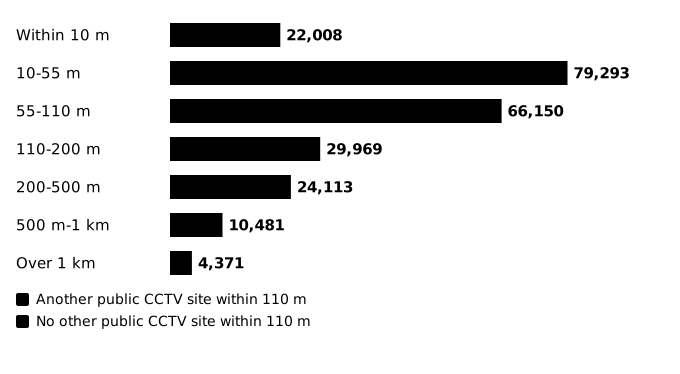
How far is the nearest public CCTV?
For each public CCTV site on Viewcone, the chart shows the distance to the nearest other site. A site groups the cameras that share one coordinate, one purpose and one managing agency, so one site can hold several cameras. Of the 253,980 map sites, I left out 17,595 whose coordinates are published only to about 100 m or 1 km, and measured distances among the other 236,385.
Half of the 236,385 sites had another site within 65 m (213 ft). For 22,008 sites, another site stood within 10 m. At the other end, 68,934 sites (29.2%) had no other site within 110 m, and 4,371 had none within 1 km (0.6 mi).
Why 110 m is the line
Viewcone draws a camera's range with the distance its agency publishes, and with 55 m when there is none. Two sites more than 110 m apart have 55 m ranges that do not touch. The 55 m figure is a reference value, not a measurement; where it comes from is in How far can a CCTV camera see?.
Only 7,204 of these 236,385 sites publish a distance. With those distances in place of 55 m, 68,853 sites (29.1%) still have a range that touches no other range, almost the same share.
Close cameras still leave blind spots
What gets recorded depends on which way each camera points, and only 792 of 253,980 map sites (0.3%) publish a direction. The rest leave the direction blank or describe it with no compass bearing, such as 360°, rotating, fixed or front. Viewcone draws the full circle around those cameras as a "possible range". Inside a possible range, a camera that faces another way does not record you.
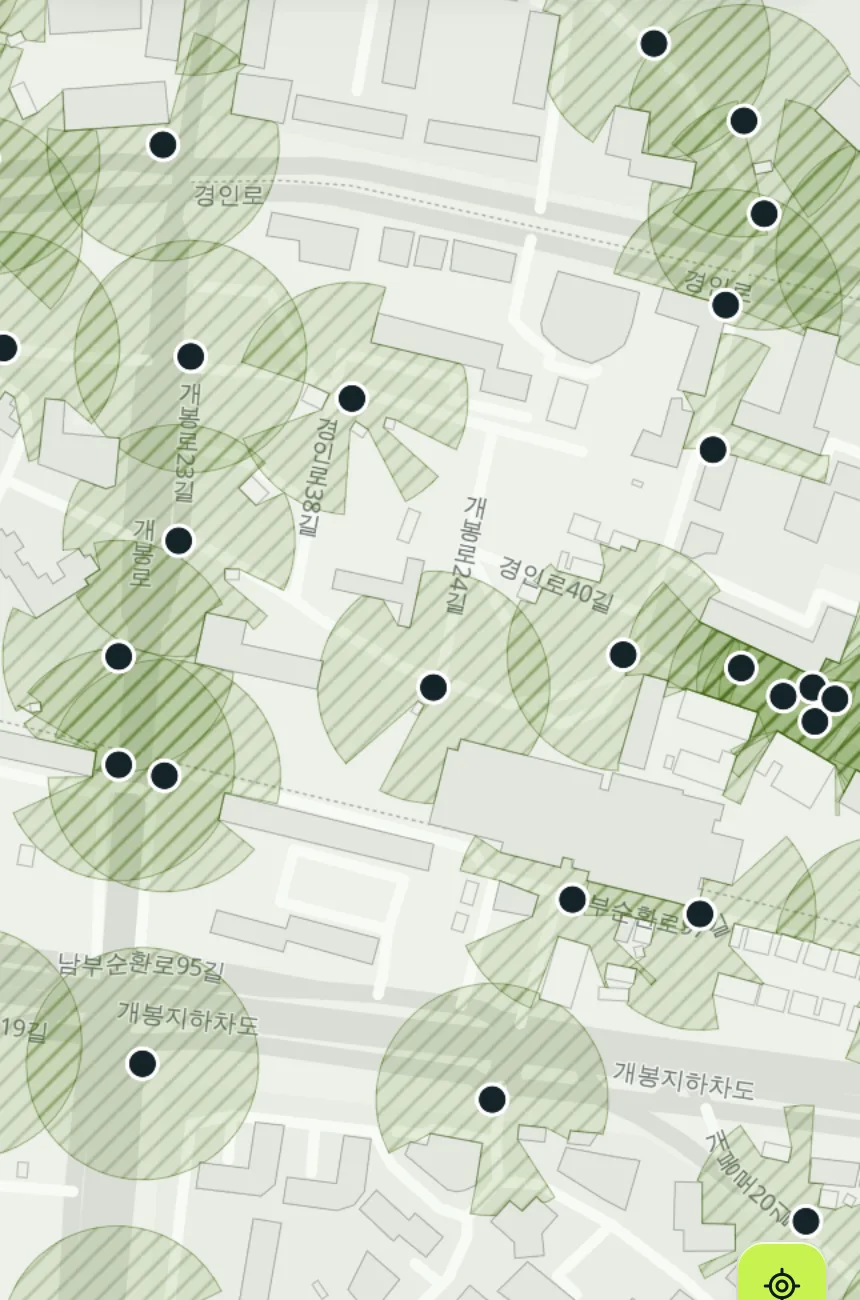
A camera cannot see past a building either, so Viewcone clips each range at building outlines. In the screenshot below, the hatched areas are possible ranges of cameras with no published direction. The ranges stop at buildings, and unhatched ground is left between them.
How to check a gap near you and ask for a camera
An empty patch on the map is not a place with no cameras at all. Cameras that apartment complexes, shops and houses put up are not in the open data, and public cameras with rough coordinates show as faint dots with no range. So the map points to likely gaps, and the last check happens on the street.
- Find gaps on the map: search for a neighborhood on Viewcone and zoom in to see public CCTV sites and their ranges. Look for stretches of your usual route that no range reaches. The interface is in Korean; How to check CCTV locations near you walks through it.
- Read the sign on site: Korean law says a CCTV sign must state the recording range and the contact of the person in charge. For a fixed camera, looking at it shows which way it points.
- Ask for a camera: if no camera covers the spot on the street either, you can ask your district (gu) or city office to install one. Criteria differ by local government. In a 2019 FAQ, Sejong City listed two of its site criteria: whether CCTV already stands near the requested spot, and whether the spot is a blind spot or crime-prone area. When you ask, describe the gap you found on the map and on the street. The steps, and English help lines for the call, are in How to get a public CCTV camera installed on your street.
FAQ
Is there a ranking of Korean areas by CCTV blind spots?
A ranking built on the open data would mislead. Local governments upload different shares of their cameras, so an area that uploaded less looks like an area with more gaps. Hwaseong in Gyeonggi Province, for example, has no list of its own in the open data, so Viewcone shows only 21 sites there.
Are child-protection cameras closer together?
Slightly, in the open data. Among the precisely located sites, the 16,395 listed for child protection had a median distance of 54 m (177 ft) to the nearest other site, against 65 m for all sites. 18.6% of them had none within 110 m, against 30.3% of the 154,949 crime-prevention sites.
Sources
Dates: the open data is the file downloaded on 2026-09-20, and each agency's records carry their own reference dates. The Personal Information Protection Act is cited in the version in force since 2026-09-11, still current on 2026-11-17.
- National CCTV standard dataset (전국CCTV표준데이터), Ministry of the Interior and Safety, Public Data Portal (Korean)
- Personal Information Protection Act (개인정보 보호법) Article 25(4), what a CCTV sign must state (Korean)
- Sejong City FAQ: CCTV installation requests, site evaluation criteria (Korean)
- Distances between sites: computed from the coordinates in the open data