How Much Slope Does a Drain Pipe Need? Why Small Pipes Get 1/4″ per Foot and Big Ones 1/8″
TL;DR
- Under the US residential code, drain pipes 2½″ and smaller need at least 1/4″ of fall per foot (about 2%); 3″ and larger need 1/8″ per foot (about 1%).
- A bigger pipe needs less slope because water flows faster in it at the same slope, fast enough to carry solids along.
- A 2″ pipe laid at only 1/8″ per foot slows to about 0.46 m/s when half full, below the 0.6 m/s minimum in Japanese drainage guidance.
- Korea and Japan use the same steps in metric: 1/50 (2%) for pipes of 65 mm or less, and 1/100 (1%) for the next sizes up.
A drain pipe 2½″ or smaller needs at least 1/4″ of fall per foot. A pipe 3″ or larger can run at 1/8″ per foot. That is the US residential code, and Korea and Japan use almost the same numbers in metric. If you know your pipe size, the table below gives your number.
Minimum slope by pipe size
The International Residential Code (IRC) splits horizontal drain pipe into two sizes. The fall is how much lower the pipe gets per foot of run.
| Pipe size | Minimum fall | Percent | Fall over 10 ft |
|---|---|---|---|
| 2½″ or smaller | 1/4″ per foot | about 2.08% | 2½″ |
| 3″ or larger | 1/8″ per foot | about 1.04% | 1¼″ |
To find the drop for your run, multiply the length in feet by the fall per foot. A 2″ drain that runs 8 feet must end at least 2″ lower than it starts.
Some states and cities amend this code or use another plumbing code. Check the code your area adopted before you set the slope.
Why a bigger pipe gets away with less slope
A drain has to move water fast enough to carry grit and waste along with it. The drainage guideline of Kobe, Japan, puts that minimum at 0.6 meters per second (about 2 feet per second). At the same slope, water moves faster in a bigger pipe. So a bigger pipe reaches that speed with less slope.
I checked the US code minimums with the Manning formula1 for a pipe that runs half full. For the pipe wall I used a roughness value of 0.012, the value that the Kobe city drainage guideline uses for its rain gutter calculation. The real speed depends on the pipe wall and how full the pipe runs, so read the numbers as a comparison between slopes.
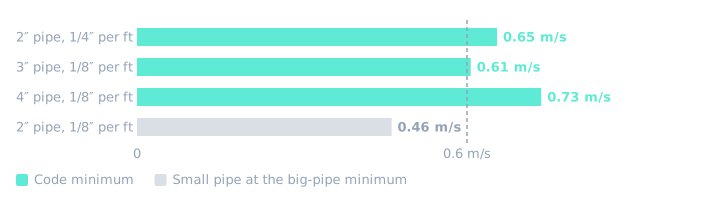
At the code minimum, all three sizes came out at 0.61 to 0.73 m/s. A 2″ pipe laid at the big-pipe minimum of 1/8″ per foot drops to about 0.46 m/s (1.5 feet per second). So don't use the 1/8″ number on a small pipe.
Korea, Japan and England
Korea's design standard (KDS 31 30 25) uses the same idea in metric. Pipes of 65 mm or less get 1/50 (2%), which means 1 mm of fall for every 50 mm of run. The next sizes, 80 to 150 mm, get 1/100 (1%), and 200 mm or more get 1/200 (0.5%). The Kobe guideline in Japan gives the same values for 65 mm or less and for 75 and 100 mm pipe, and splits the bigger pipes more finely: 1/150 for 125 mm and 1/200 for 150 mm or more.
England's building guidance (Approved Document H) looks at how much water flows as well as at the size. A 100 mm drain that carries little water at its peak, under 1 liter per second (about 16 gallons per minute), should fall at least 1:40 (2.5%). A drain with at least one toilet and a peak above 1 liter per second can go as flat as 1:80 (1.25%).
How to check the slope of your pipe
You can check the fall with a level and a tape over a known length, or read it on the pipe with a phone. Here is how to do it with PitchFall, a slope level app for phones.
- Find the pipe size and pick the minimum from the table above.
- In PitchFall's pipe mode, set the target: pick 1/4″ or 1/8″ per foot, or type your own value.
- Stand the phone on its edge on top of the pipe. The screen shows on target, too flat or too steep.
- When it's off target, it tells you which end to move and by how much, for example "Raise right end 3/32″".
The PitchFall post shows how to set the units.
Sources
- New York State, 2020 Residential Code of New York State, section P3005.3 (the state edition of the 2018 International Residential Code)
- City of Kobe, drainage facility guideline, chapter 2: indoor drainage (Japanese), section 2-6, table 2-1 and notes; table 2-17, note 4
- Ministry of Land, Infrastructure and Transport (Korea), KDS 31 30 25 drainage and vent design standard, revised February 23, 2026 (Korean), table 4.1-1
- UK Government, Approved Document H: Drainage and waste disposal (2015), table 6