How Many Years of Security Updates Does an iPhone Get? Over 10, but Not the Same Fixes
TL;DR
- Apple does not announce when an iPhone's security updates end. The iPhone 6s, released in 2015, still got one on May 11, 2026.
- The same day, iOS 26.5 fixed 68 security issues, while iOS 15.8.8 for the iPhone 6s and 7 and iOS 16.7.16 for the iPhone 8 and X each fixed one.
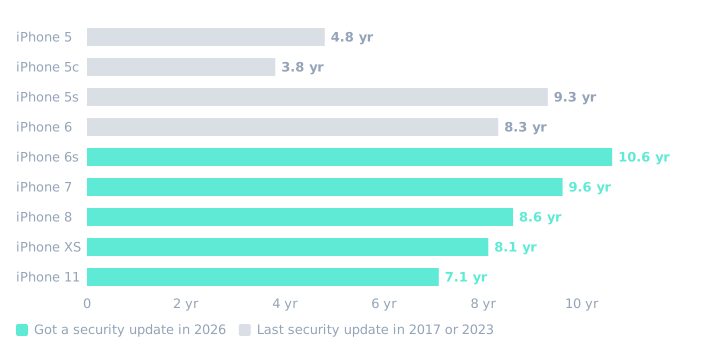
- The iPhone 5, 5c, 5s and 6, whose last security update came by January 2023, got them for 3.8 to 9.3 years after release.
Apple does not say when an iPhone stops getting security updates, but the iPhone 6s from 2015 still got one on May 11, 2026. That is 10 years and 7 months after it came out. But that day the newest iOS fixed 68 security issues, and the update for the iPhone 6s fixed one.
Years of updates by model
For each update, Apple's security releases list names the devices that can install it. For each model I took the newest security update on that list and counted from the day the phone went on sale. The chart draws one bar for models that came out together and got the same updates, such as a Plus, and leaves out the first-generation SE, the X and the XR, and the iPhone 12 and later, which get the same updates as the iPhone 11. Updates that Apple marks as having no security fixes are not counted.
The four iPhones whose last security update came by January 2023 got them for 3.8 to 9.3 years. The iPhone 5 and 5c got their last security update, iOS 10.3.3, in July 2017, and iOS 11, which came next, does not support them. For the iPhone 5s and 6, the last one was iOS 12.5.7, in January 2023. One more iOS 12 update came out in January 2026, but Apple lists no security fixes in it.
Every model from 2015 on got a security update in 2026. The iPhone 6s, 7 and first-generation SE run iOS 15, and the iPhone 8 and X run iOS 16. Both versions last got a security update on May 11, 2026, and none in the six months since. The iPhone XS and XR run iOS 18, and the iPhone 11 and later run iOS 26 or 27. All three versions got one on November 9, 2026.
Same day, different number of fixes
What an update fixes is listed in the security note Apple publishes with it. The note names each fixed issue by its CVE number. A CVE is a shared ID given to one publicly disclosed security flaw.1 The update the iPhone 6s got in May fixed exactly one, CVE-2026-28950. Counting the CVE numbers in a note tells you how many fixes Apple lists by CVE number.
On May 11, 2026, Apple shipped security updates for four iOS versions. The chart shows the CVE count in each one's note.
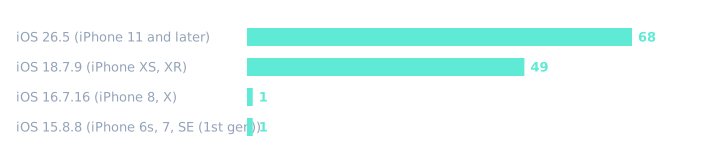
The updates for the iPhone 6s and the iPhone 8 fixed the same single issue: notifications marked for deletion could stay on the device. The same day, iOS 26.5 for the iPhone 11 and later fixed 68, and iOS 18.7.9 for the iPhone XS fixed 49. Apple does not say whether the 68 issues fixed in iOS 26.5 also exist in iOS 15. But the iPhones on the newest iOS clearly got far more fixes that day. An old iPhone that still gets updates is not getting the same fixes as one on the newest iOS.
Apple's minimum: 5 years
Instead of an end date, Apple has published a minimum period for the UK. Under the UK's product security law (PSTI), its statement for each model from the iPhone 11 on promises at least 5 years from the date the model was first supplied in the UK. For the Galaxy and Pixel periods next to the iPhone, see when phone security updates end, and for why routers have no such date, see device update end dates.
The iPhone 11's 5-year minimum ended in September 2024, and it still got a security update in November 2026. Once the minimum has passed, though, nothing tells you in advance when the updates will stop.
Check your iPhone's last security update
On the iPhone, Settings, General, About shows the installed iOS version, and Settings, General, Software Update shows whether an update is available. Install any update it offers first. To see when your model last got one, use safeuntil.
- On safeuntil, which lists the security update record of routers, IP cameras and phones by model, type a model name such as "iPhone 6s".
- The device page shows the release date, the "Last security patch" date and the iOS version.
- If no new update has come for 6 months after the last one, the status changes to "Likely ended", marked as an estimate. The iPhone 6s, 7, 8 and X show "Likely ended" now.
- It also shows an estimated count of fixes that went out in other devices' updates but not in this model's.
Sources
Apple's dates are as Apple lists them, with no time zone.
- Apple, Apple security releases, 2022 to 2023 list, 2018 to 2019 list, 2016 to 2017 list
- Apple security notes: iOS 26.5, iOS 18.7.9, iOS 16.7.16, iOS 15.8.8
- Apple, Find the iOS version, Update your iPhone
- Apple, UK PSTI statements (iPhone 11, statement of April 29, 2024)
- CVE Program, About the CVE Program
- Release dates: Apple Newsroom announcement for each model
Footnotes
-
CVE (Common Vulnerabilities and Exposures) is a program that identifies, defines and catalogs publicly disclosed security flaws, with one record for each flaw, so companies and agencies can refer to the same flaw by the same number. The number carries no severity score, so a count tells you how many fixes Apple lists by CVE number, not how serious they were.