What Goes in a Go Bag? The Ready.gov Checklist With Quantities for Your Household
TL;DR
- FEMA's Ready.gov kit starts with water (1 gallon per person per day), several days of food, a radio, a flashlight, a first aid kit and 9 more basic items.
- Water is the heaviest item: 3 days for one person is 3 gallons, about 25 pounds.
- Ready.gov asks you to replace expired items and rethink the kit every year, and the CDC says to replace water you bottled yourself every 6 months.
A go bag holds the 14 basic items of FEMA's Ready.gov kit list, plus additional supplies such as medications, cash, documents, bedding, clothes and matches. Water is the only item on the list with a set daily amount, and it is also the heaviest. Most other items are one per household.
The 21 items and how many of each
Ready.gov's Build a Kit page has two lists: 14 items for a basic disaster supplies kit and 16 additional supplies. The table below takes all 14 basic items and 8 of the 16 additional supplies. The 8 take 7 rows, because prescription and non-prescription medications share one. It sorts them into the five groups that the Safe-Life app uses for its checklist. "Per household" means one for the whole household.
| Group | Item | Ready.gov list | How many |
|---|---|---|---|
| Water and food | Water | Basic | 1 gallon per person per day |
| Water and food | Non-perishable food | Basic | At least several days per person |
| Water and food | Manual can opener | Basic | Per household |
| Light and communication | Battery-powered or hand crank radio | Basic | Per household |
| Light and communication | Flashlight | Basic | Per household |
| Light and communication | Extra batteries | Basic | Per household |
| Light and communication | Cell phone chargers and a backup battery | Basic | Per household |
| Light and communication | Whistle | Basic | Per person |
| First aid and hygiene | First aid kit | Basic | Per household |
| First aid and hygiene | Prescription and non-prescription medications | Additional | Per person's needs |
| First aid and hygiene | Dust mask | Basic | Per person |
| First aid and hygiene | Moist towelettes, garbage bags and plastic ties | Basic | Per household |
| First aid and hygiene | Soap and hand sanitizer | Additional | Per household |
| Shelter and tools | Plastic sheeting, scissors and duct tape | Basic | Per household |
| Shelter and tools | Wrench or pliers | Basic | Per household |
| Shelter and tools | Local maps | Basic | Per household |
| Shelter and tools | Sleeping bag or warm blanket | Additional | Per person |
| Shelter and tools | Change of clothes and sturdy shoes | Additional | Per person |
| Shelter and tools | Matches in a waterproof container | Additional | Per household |
| Cash and documents | Cash | Additional | Per household |
| Cash and documents | Copies of important documents | Additional | Per household |
Ready.gov gives a per-person amount only for water and for the sleeping bag or blanket. The table also counts the whistle, the dust mask and the change of clothes per person, because each person signals, breathes and dresses on their own.
For food, Ready.gov asks for "at least a several-day supply" with no calorie figure. The Sphere Handbook, an international standard for humanitarian aid, plans food at 2,100 calories per person per day, so 3 days of food for one person is 6,300 calories.
Ready.gov's other 8 additional supplies are glasses and contact lens solution, infant formula and diapers, pet food, feminine supplies, a fire extinguisher, mess kits, paper and a pencil, and games for children. Add the ones that fit your household.
Water sets the weight of the bag
Water is the one item with a fixed daily amount, and a gallon of water weighs about 8.3 pounds. The American Red Cross asks for a 3-day supply for evacuation. At 1 gallon per person per day, that comes to:
| Household | Water for 3 days | Weight of the water |
|---|---|---|
| 1 person | 3 gal (11.4 L) | about 25 lb (11 kg) |
| 2 people | 6 gal (22.7 L) | about 50 lb (23 kg) |
| 3 people | 9 gal (34.1 L) | about 75 lb (34 kg) |
| 4 people | 12 gal (45.4 L) | about 100 lb (45 kg) |
For a family of four, 3 days of water weighs about 100 pounds, more than one adult can carry far. Ready.gov suggests one or two easy-to-carry containers, such as plastic bins or a duffel bag. For a family, put a share of the water in each adult's bag and the rest in jugs or a bin by the door, ready for the car. The emergency water post has the amounts for 1 week and 2 weeks.
How to check the bag and keep it current
A bag packed once does not stay ready. Ready.gov asks you to replace expired items as needed and to rethink your needs every year. The CDC says to replace water you bottled yourself every 6 months and to replace store-bought water by the date on its label. Food and medicine each run out on a different date, and the emergency kit expiry post lists the period for each.
To check your own bag against the list:
- Lay out what is in the bag and tick each of the 21 items in the table above. For water and food, count gallons (or liters) and days against your household size.
- Write down the date on each food, medicine and water package, and replace anything that expires within a month.
- Replace water you bottled yourself if it is more than 6 months old.
- Go through the list again once a year, and whenever your household changes: a new baby, a new medication, a pet or a move.
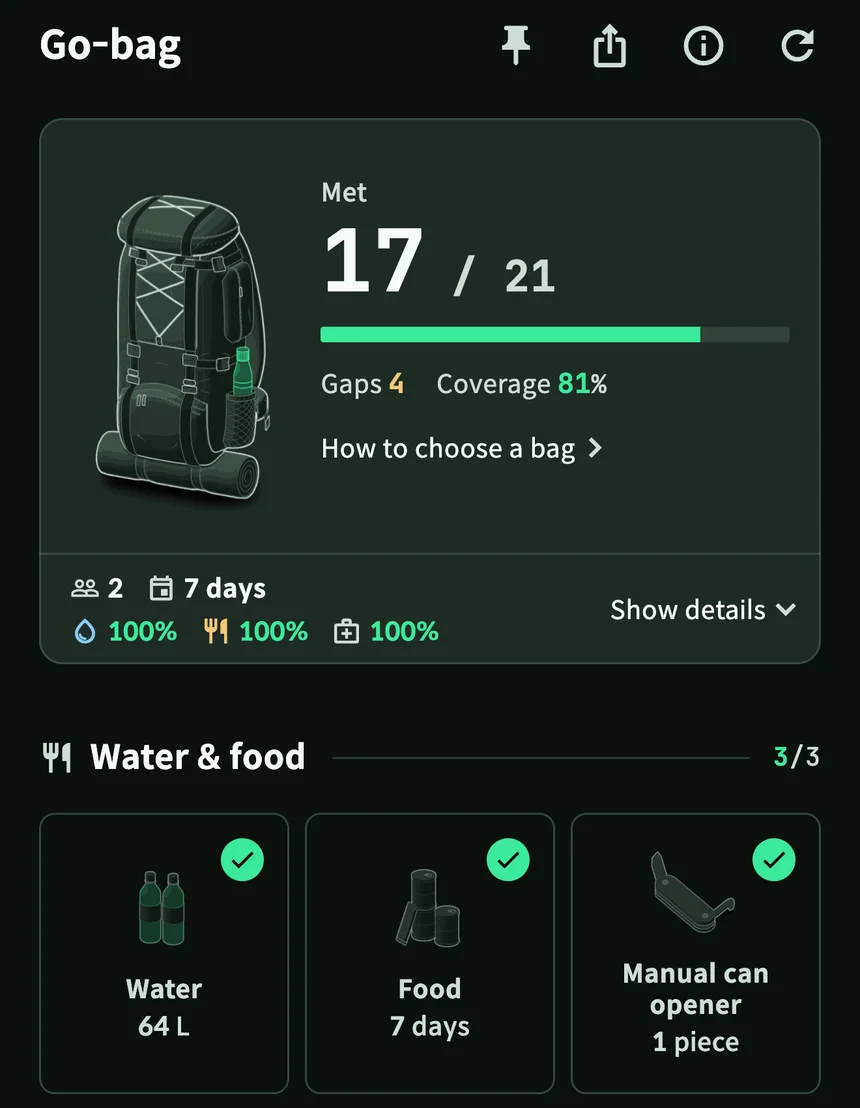
- In Safe-Life's Go-bag tab, check each item as you pack it and enter the package dates. The tab shows what is still missing, and the app reminds you 30 days before an item expires and on its last day.
Sources
- Build a Kit - Ready.gov (FEMA), updated July 1, 2026: the 14 basic items and 16 additional supplies, one or two easy-to-carry containers, replace expired items, rethink your needs every year
- Water - Ready.gov (FEMA): one gallon per person per day for several days, for drinking and sanitation
- How to Create an Emergency Water Supply - CDC, June 27, 2025: replace self-filled water every 6 months, observe the expiration date of store-bought water
- Survival kit supplies - American Red Cross: a 3-day supply for evacuation, a 2-week supply for home
- The Sphere Handbook: 2,100 calories per person per day for emergency food planning