Got a data breach notice? What should you do first?
TL;DR
- Read the list of leaked items in the notice first, because your steps depend on what leaked.
- On November 14, 2026, 526 of the 1,414 breaches outside Korea in safeuntil listed no password, card, bank account or ID number. For most of those, the main step is to doubt calls, texts and emails about the breach.
- Change a leaked password on every site where you used it, and ask the card issuer to cancel the card and send a new one.
- If a Social Security number leaked, freeze your credit at Equifax, Experian and TransUnion; the US FTC says the freeze is free.
Start with the list of leaked items in the notice. If only your name and contact details leaked, the main step is to be wary of messages about the breach; a leaked password, card, bank account or ID number adds steps.
What breaches usually leak
In the EU, Article 34 of the General Data Protection Regulation (GDPR) requires a notice, with a few exceptions, when a breach is likely to put you at high risk. In the US, every state, the District of Columbia, Puerto Rico and the Virgin Islands have breach notice laws, says the Federal Trade Commission (FTC).
What leaked differs from breach to breach. To see the usual mix, I counted the items in the breach check of safeuntil, a site that devrives makes. I left out its Korean breaches, which the Korean version of this post covers, and kept the other 1,414. Email address led, in 1,195 of the 1,414 breaches.
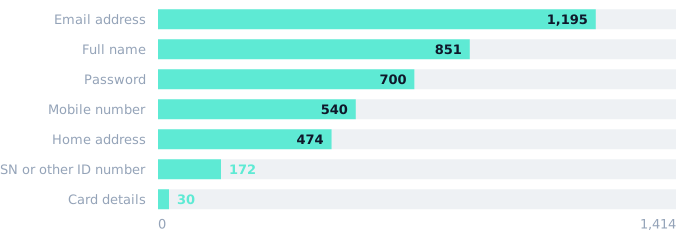
Have I Been Pwned lists breaches of online accounts, and 656 of the 700 breaches with a password come from it. The other 400 breaches come from company notices and filings, regulators, courts and the press. They hold most ID numbers: 129 of the 172 breaches with an ID number.
If no password, card, bank account or ID number leaked
526 of the 1,414 breaches listed none of these four. Your name, email address, phone number and home address are hard to change, and a scammer who knows them can sound real. The FTC's IdentityTheft.gov says that scammers often pretend to be a business you know.
- Treat calls, texts and emails about the breach as unverified, even when they use your name.
- Do not tap links in such a message, even if it looks real.
- Contact the company through a website you know or a phone number you look up yourself.
If a password, card or bank account leaked
Unlike your name, these can be replaced.
- Password: change it on the breached site, and on every other site where you used the same password. Then turn on two-factor authentication, which asks for a second code on top of the password.
- Card: ask your bank or card issuer to cancel the card and send a new one. Use the phone number on the back of the card, not one from a message. Then check your statements for charges you do not recognize.
- Bank account: tell your bank, close the account and open a new one.
If your Social Security number or another ID number leaked
172 of the 1,414 breaches listed a Social Security number (SSN), national ID, driver's license, passport or other ID document number. These numbers are hard to change, so the steps make it harder for someone to open new accounts with them. For people in the US, IdentityTheft.gov gives these steps:
- Freeze your credit at each of the three US credit bureaus: Equifax, Experian and TransUnion. While the freeze is in place, nobody can open a new credit account, and placing or lifting it is free.
- You can also place a free one-year fraud alert. For this one, contacting one of the three bureaus is enough. A business then has to verify your identity before it opens an account.
- Get your free credit reports at AnnualCreditReport.com and look for accounts you do not know.
For a driver's license, IdentityTheft.gov also says to report it to your state's motor vehicle office.
Check your email on Have I Been Pwned, and your steps on safeuntil
The two services answer different questions, so you can use both.
| Service | You enter | It tells you |
|---|---|---|
| Have I Been Pwned | An email address | Which breaches in its list contain that address |
| safeuntil breach check | The name of a company you used | What leaked in that breach, and the steps for it |
Have I Been Pwned is a free service that security researcher Troy Hunt has run since 2013. On November 14, 2026 its list held 1,052 breaches, and its Notify Me feature emails you when your address shows up in a new one. safeuntil skips spam lists, fake breaches and a few other kinds, and last copied the list on November 4, 2026, so it holds 1,014 of them.
To get the steps for the breach in your notice:
- Type the company name from the notice into the safeuntil breach check. It does not ask for your email address or phone number.
- Read what leaked and the to-do list. Most to-dos show about how long they take; tap one to see how to do it.
- Tap the circle at the start of a to-do to mark it done. If several companies sent notices, add each company, and their to-dos form one list.
FAQ
Should I accept the free credit monitoring that the company offers? IdentityTheft.gov says to accept it. A monitoring service usually alerts you when something new shows up on your credit report, such as a new loan or credit card.
Can I get a new Social Security number? Usually not. IdentityTheft.gov says that in most cases the Social Security Administration gives a new number only with evidence that someone else is misusing yours.
Sources
- Regulation (EU) 2016/679 (GDPR), Article 34, EUR-Lex
- FTC: Data Breach Response, A Guide for Business
- IdentityTheft.gov: What to do if your information was lost or stolen, or part of a data breach
- Have I Been Pwned
- Have I Been Pwned: Who, What & Why
- Have I Been Pwned: FAQs
- Have I Been Pwned: API licence (CC BY 4.0)