Air Raid Alerts in Korea: What the Sirens and Emergency Texts Mean
TL;DR
- Korea's alert (경계경보) means an attack is expected and comes by loudspeaker broadcast and emergency text with no siren. The air raid warning (공습경보) means an attack is imminent or under way and comes with a 1-minute siren.
- The rule describes the air raid siren as 5 seconds up and 3 seconds down, 7 times. In the official Suwon City recording we measured, that rise shows up as about 2 seconds of climbing plus a 3-second hold at the top, then a 3-second fall: an 8-second cycle. A siren that stops after 12 seconds is a natural disaster warning.
- Emergency texts are in Korean but end with an English tag. EVACUATION, AIR RAID or EVACUATION, MISSILES ATTACK means get underground or inside a building now; MISSILES ALERT means watch for falling debris and stay off the street.
- The all-clear comes as a lower-priority safety text with no English tag, so look for the word 해제 (haeje, lifted).
If a siren in Korea rises and falls for a full minute, it is an air raid (or nuclear) warning: go underground or into a building without windows right away. The lower level, an alert, has no siren at all. It arrives as a loudspeaker announcement and a phone text and usually means get ready. A siren that stops after 12 seconds is about a natural disaster such as a typhoon or wildfire, not an attack.
This guide is for people in Korea who do not read Korean easily: foreign residents, students, military families and travelers. It is drawn from Korea's civil defense alert regulation (민방위 경보 발령·전달 규정, the version in force since January 5, 2026) and its annexes. In a real event, the official broadcast and the text on your phone come first.
Five warnings, one table
Korean civil defense (민방위, minbangwi) has five warnings for an enemy attack. The Korean names are worth recognizing, because the phone text uses them.
| Warning | Korean | When it is issued | Siren | Phone alert | What to do |
|---|---|---|---|---|---|
| Alert | 경계경보 (gyeonggye gyeongbo) | An attack is expected | None (voice broadcast) | Emergency alert | Get ready; evacuate at once if an aircraft attack is expected |
| Air raid warning | 공습경보 (gongseup gyeongbo) | An attack is imminent or under way | 1 minute rising and falling, plus broadcast | Emergency alert | Underground or into a windowless building now |
| Chemical, biological or radiological warning | 화생방경보 | Agents are released or detected, contamination is expected, or an attack is confirmed | None (voice broadcast) | Emergency alert | Cover your nose and mouth, go indoors and upstairs |
| Nuclear warning | 핵 경보 | A nuclear attack is imminent or under way | 1 minute rising and falling, plus broadcast | Emergency alert | Sealed shelter or deep underground space |
| All clear | 경보해제 (gyeongbo haeje) | The threat has passed | None (voice broadcast) | Safety guidance text | Return to normal |
Only two of the five come with a siren, the air raid warning and the nuclear warning, and both sound the same. The broadcast and the text that follow tell you which one it is.
Reading the emergency text on your phone
Phones in Korea receive these warnings as emergency alerts, and the regulation fixes their wording (Annex 9). Each one runs in the same order: time, cause, region, warning type, what to do, then a short English tag and the sending agency. Agencies may adjust the wording for the region and situation, but the template is the baseline. An alert for an aircraft attack, for example, reads:
○○:○○ 북한 항공기 침범, ○○, ○○지역 경계경보, 지하시설 또는 건물 내로 대피. EVACUATION, AIR RAID [agency]
The English tag at the end is the part to look for.
| English tag | Warning behind it | What the Korean part says |
|---|---|---|
| EVACUATION, AIR RAID | Alert or air raid warning for aircraft | 지하시설 또는 건물 내로 대피: evacuate to an underground facility or into a building |
| MISSILES ALERT | Alert for a missile launch | 낙하물 유의, 야외활동 자제: watch for falling objects, avoid being outdoors |
| EVACUATION, MISSILES ATTACK | Air raid warning for missiles | Evacuate underground or into a building |
| EVACUATION, ARTILLERY ATTACK | Air raid warning for shelling | Evacuate underground or into a building |
| EVACUATION, BIOLOGICAL ATTACK | Biological warning | 호흡기 보호, 대피: protect your breathing, evacuate |
| EVACUATION, CHEMICAL ATTACK | Chemical warning | 호흡기 보호, 높은 곳 대피: protect your breathing, move to higher floors |
| EVACUATION, NUCLEAR ATTACK | Nuclear warning | Evacuate underground or into a building |
Two details trip people up:
- An alert about aircraft carries the same tag as an air raid warning. Both say EVACUATION, AIR RAID, and both tell you to move. The tag alone does not tell you the level, but the action is the same.
- The all-clear has no English tag. It is sent on the lower-priority safety guidance channel and reads "...경보 해제, 일상으로 복귀 바랍니다" (warning lifted, please return to normal). Until you see 해제, treat the warning as still in force.
Ordinary disaster texts are getting easier to read too. Since 2024, the Ministry of the Interior and Safety and the Korea Meteorological Administration have been adding brief English keywords to mobile disaster alerts, such as "Earthquake" with the magnitude.
A few Korean words cover most of what you will see or hear:
| Korean | Pronunciation | Meaning |
|---|---|---|
| 대피 | daepi | Evacuate, take shelter |
| 해제 | haeje | Lifted (the all-clear) |
| 실제상황 | silje sanghwang | This is a real situation, not a drill |
| 민방위 대피소 | minbangwi daepiso | Civil defense shelter |
How the civil defense siren sounds
Siren equipment in Korea uses three patterns, so the shape and length of the sound already tell you a lot.
| Sound | Length | Meaning |
|---|---|---|
| Rising and falling (5 s up, 3 s down, 7 times) | 1 minute | Air raid warning or nuclear warning |
| Short rise and fall (2 s up, 2 s down, 3 times) | 12 seconds | Natural disaster warning (tsunami, typhoon, heavy rain, wildfire and similar) |
| Steady tone with no change in pitch | 1 minute | Siren sounded for a non-civil-defense purpose, announced in advance |
The 12-second disaster siren used to be for tsunamis only. Since the January 5, 2026 revision, it can also sound for typhoons, heavy rain and wildfires when residents need to leave quickly; the revision cites "ultra-fast wildfires" and "extreme rainfall". So a siren in the rainy or wildfire season is not necessarily about an attack, and if it ends after 12 seconds, it is a disaster warning.
The air raid siren itself was shortened from 3 minutes to 1 minute starting with the August 2023 civil defense drill, and alerts and all-clears no longer use a siren at all.
What we measured in an official recording
To hear what "5 seconds up, 3 seconds down" sounds like, we downloaded the civil defense siren recording that Suwon City publishes on its website for residents to listen to, and analyzed its pitch every 0.05 seconds.
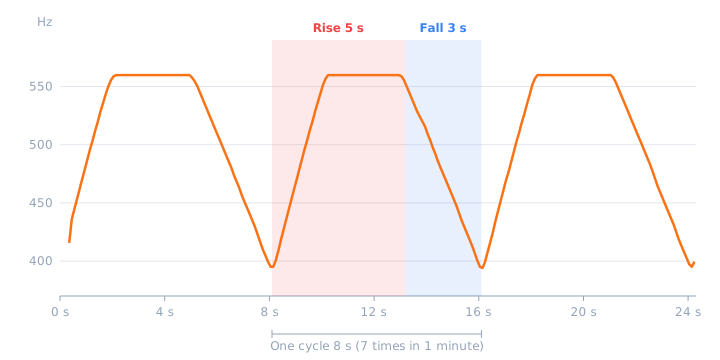
| Measurement | Result |
|---|---|
| One cycle | 8.0 s on average (8.0 to 8.05 s across 21 cycles) |
| Rising part | About 2.1 s of climbing, then 3.0 s held at the top: about 5.1 s together |
| Falling part | About 2.9 s |
| Whole recording | About 3 min 6 s (185.8 s), 23 rises and falls |
In this recording, the "5 seconds up" is not one long climb. The pitch shoots up in about 2 seconds, holds a high wail for 3, then slides down for 3, and the pattern comes back every 8 seconds.
The recording is also longer than today's siren. Its file path dates it to January 2021, when an air raid siren still ran for 3 minutes. A real air raid warning now sounds the same cycle for 1 minute (8 seconds × 7). If a sample you find online lasts 3 minutes, it follows the old rule.
If you get an alert text
An alert means an attack is expected, so most of the time it is about getting ready. What to do depends on the kind of attack, and the regulation's broadcast script splits the two cases.
If enemy aircraft are expected, the alert already asks for the same action as an air raid warning: go underground or into a building, and if you are driving, pull over in an open area or on the right side of the road. The text says the same: 지하시설 또는 건물 내로 대피, EVACUATION, AIR RAID.
If it is a missile launch or anything else, the text says MISSILES ALERT and the broadcast asks you to prepare:
- Be ready to evacuate at once, and move children and older people first.
- If you are driving, slow down and stay out of overpasses and city centers; better not to drive at all.
- Check a gas mask or anything that can stand in for one.
- Put daily necessities and regular medicines together. For how much water to keep, see how much emergency water to store per person.
An air raid warning can also be stepped down to an alert. The broadcast for that step asks people to stay on guard: the danger is lower, not over.
When the air raid siren goes off
The air raid warning means an attack is about to happen or has started. The broadcast script lists these steps:
- Go straight into an underground facility or a building without windows. The 2023 drill guidance adds that if there is no civil defense shelter nearby, a safe underground space will do.
- If you are driving, stop in an open area or on the right side of the road and evacuate with everyone else.
- If you have a gas mask or other protective gear, put it on as you move, in case of a chemical or biological attack.
- Once inside, close the doors and keep away from window glass.
- Keep order in the shelter and follow the instructions that keep coming over the broadcast.
The air raid script itself does not say how long to stay. In the 2023 nationwide drill, people stayed in shelters until the air raid warning was lowered to an alert, then could leave and move about while staying on guard, and returned to normal when the all-clear came.
Crowded places such as theaters, stadiums, terminals and department stores are required to stop business and move people out, so follow staff directions there.
At night (sunset to sunrise) there is one more step: switch off every light inside and outside your home or building before you leave. Drivers who stop should turn off headlights and interior lights too.
If the warning is nuclear, chemical or biological
Nuclear warning: get as deep and as sealed off as you can.
- Go to a shelter or underground space cut off from the outside as far as possible, and protect yourself from debris shaken loose by shock and vibration.
- If there is no time to get to shelter, move away from the direction of the fireball and use ditches or other cover outside to limit your exposure to radiation and blast.
- If you see a flash or other sign that the attack has started, do not move more than two or three steps. Get down at once behind a ditch or cover, away from the blast, and stay lying flat until the blast wind stops.
- After the attack, if you were exposed to radiation or radioactive material, shower with warm water and soap. Where you cannot, take off your outer clothes, wipe your skin with a wet towel, seal the clothes in a plastic bag and change into clean ones.
Chemical or biological warning: the opposite direction, go up and seal in. The script sends people indoors and to higher floors rather than underground.
- Without a gas mask, cover your nose and mouth with a wet towel or mask, and reduce bare skin with something like a plastic raincoat.
- Indoors, close doors and windows, seal the gaps with wet towels, newspaper or tape, and switch off air conditioners, fans and air purifiers.
- Outside, check the wind: if it blows from you toward the contaminated area, move upwind; if it blows from the contaminated area toward you, move across the wind.
Finding a shelter when you don't read Korean
Civil defense shelters are designated places meant to protect people from blast and fragments during an air or missile attack. The Ministry of the Interior and Safety's civil defense page lists where to look them up: the Naver and Daum portals, Naver Map, Kakao Map, T map, the national disaster safety portal and the 안전디딤돌 (Anjeon Didimdol) app. The simplest approach in any of the map apps is to paste the Korean term 민방위 대피소 into the search box, which works even if you cannot read every result.
Two of those have changed recently:
- The portal is now 국민안전24. On April 30, 2026 the ministry reorganized the national disaster safety portal into 국민안전24, which shows disaster texts, shelter locations and action guidelines in one place. It also opened a separate site for foreigners, with information in 22 languages instead of English only, so about 2.64 million foreign residents can read it in their own language.
- There are two 안전디딤돌 apps on Google Play. The older one is now labeled "(구)안전디딤돌" (old). The current 안전디딤돌, updated September 8, 2026, lists civil defense shelter locations among its features and says its action guidelines for each type of disaster work even when networks are down. Its store listing is in Korean and does not mention other languages.
The ministry's English app, Emergency Ready App, is described in a December 2025 Ministry of Justice notice as offering alerts in English, Chinese, Japanese, Vietnamese and Thai, plus shelter locations. As of October 14, 2026, the App Store lists it as "(Old)Emergency Ready App", so check the listing before relying on it.
Look up the shelters near your home, workplace and your children's school once, while everything works, and take a screenshot of the map so you can open it without a connection.
The same steps, offline in Safe-Life
The checklists above are long to remember under stress. Safe-Life, a free Android app, carries civil defense alerts among its disaster guides, in English as well as Korean, and every guide opens without internet. Its go-bag checklist covers the alert broadcast's "put daily necessities and medicines together": you record the quantity and expiry date of what is in the bag, so when an alert arrives you can see what is missing. It has no shelter map.
Sources
- Civil defense alert issuance and transmission regulation (민방위 경보 발령·전달 규정), National Law Information Center (in force January 5, 2026, checked October 14, 2026): Article 4 warning types, Article 10 emergency vs safety guidance texts, Article 14 wider use of the disaster siren and the reasons for the revision, Annex 1 siren patterns, Annex 3 broadcast scripts (day, night, chemical and biological, nuclear), Annex 9 text templates with English tags
- Civil defense system, Ministry of the Interior and Safety (Korean): siren patterns, definition of civil defense shelters, where to look them up
- Nationwide civil defense drill on August 23, Korea.kr policy briefing (August 17, 2023, Korean): air raid siren cut from 3 minutes to 1, no siren for alerts and all-clears, a safe underground space when no shelter is near, leaving the shelter once the warning is lowered to an alert
- Civil defense siren samples, Suwon City (Korean): the recording we measured
- Emergency mobile alerts to contain English keywords, The Korea Times (February 28, 2024)
- Essential App for Foreign Residents in Korea (Emergency Ready App), Ministry of Justice (December 24, 2025)
- Emergency Ready App, App Store (listing checked October 14, 2026)
- Disaster and safety information in one place on 국민안전24, Ministry of the Interior and Safety (press release, April 29, 2026, Korean): the reorganized portal from April 30 and the 22-language site for foreigners
- 안전디딤돌, Google Play (listing checked October 14, 2026, Korean): shelter locations and offline action guidelines
FAQ
Does a drill siren sound different from a real one? No, the sound is the same. The difference is the announcement: in a real event the script has the broadcaster say that an actual air raid warning is being issued and that this is a real situation (실제상황). Nationwide civil defense drills are announced by the government in advance.
What if a warning turns out to be a mistake? The regulation requires a correction to go out by text and over the siren loudspeakers once a false alarm is confirmed. Until you receive that correction or an all-clear, the safe choice is to act as if the warning is real.